My favorite fly fishing books of 2025, and ten other standout reads
Looking for your next great read? Here are a few recommendations, fly fishing-related and non-, as well as a few opinions on what makes good writing.
𓆟 𓆝 𓆟
Happy new year! We're back at it. Last time we talked about a few favorite fish. This time I want to touch on a few of the favorite fly fishing books I read last year.
A slight preface: I love to read. After family and friends, reading is my greatest pleasure. I might even love to read more than I love fishing. (Shh, don't tell.) Any modest writing talent I have is entirely a result of my love of reading, and the time spent absorbed in books, newspapers, and magazines. If you want to write well, reading is the raw material.
Slowing from my normally aggressive reading schedule
This year was a little bit of a downturn in the sheer quantity of books read. I read 40-something books. (Yes, I keep a list, previously in public). That's down a good 10-15 from an average year. In a good year, I read just over one book a week.
I'm not sure of the exact reason why last year was slower than average. Partly, I think, because I was pretty hung up on "current events." I'm not entirely happy with the amount of time I spent peering at my phone in abject horror, then scrambling around to swap the algorithm to bonkers delights to try and dull the frustration. On a happy note, a few of the books I read last year talked about why that routine is such a bad idea and what one might do about it. (Spoiler alert: The horror and delight are basically neuro-chemically the same thing.)
I still managed to read a bunch of fly fishing books
I tend to lump all fly fishing books in either the "technique" or "lore" categories. The difference should be fairly self-explanatory, but for the folks in the back, technique books tell you what to do, in detail. They often have diagrams and charts. Lore books tell fishing stories, and occasionally explain the more technique-y bits. "The tippet is..." or "Backing helps..." Though almost all those asides feel like they're mostly so the book can be inclusive of non-anglers. So the book's editor can tell their boss it'll be relevant to a cross-over audience. (It won't.)
The gulf between these two types is fluid. All technique books all have a bit of lore in them. The best type of fly fishing book transcends, and has both. I'm not sure if technique alone is enough to anchor a book, in 2025, where we can get so much "How to" information elsewhere. I'll try not to slip into a cranky aside about the reliability of fly fishing information on the internet here, but I feel like there's an excellent opportunity to remake how fly fishing technique is presented in print form, in light of this very pressure. One book I read this year was able to do that very effectively.
Anyway, on to the books. These are a mixture of old and new, not just books published in 2025.
Favorite fly fishing technique books I read in 2025
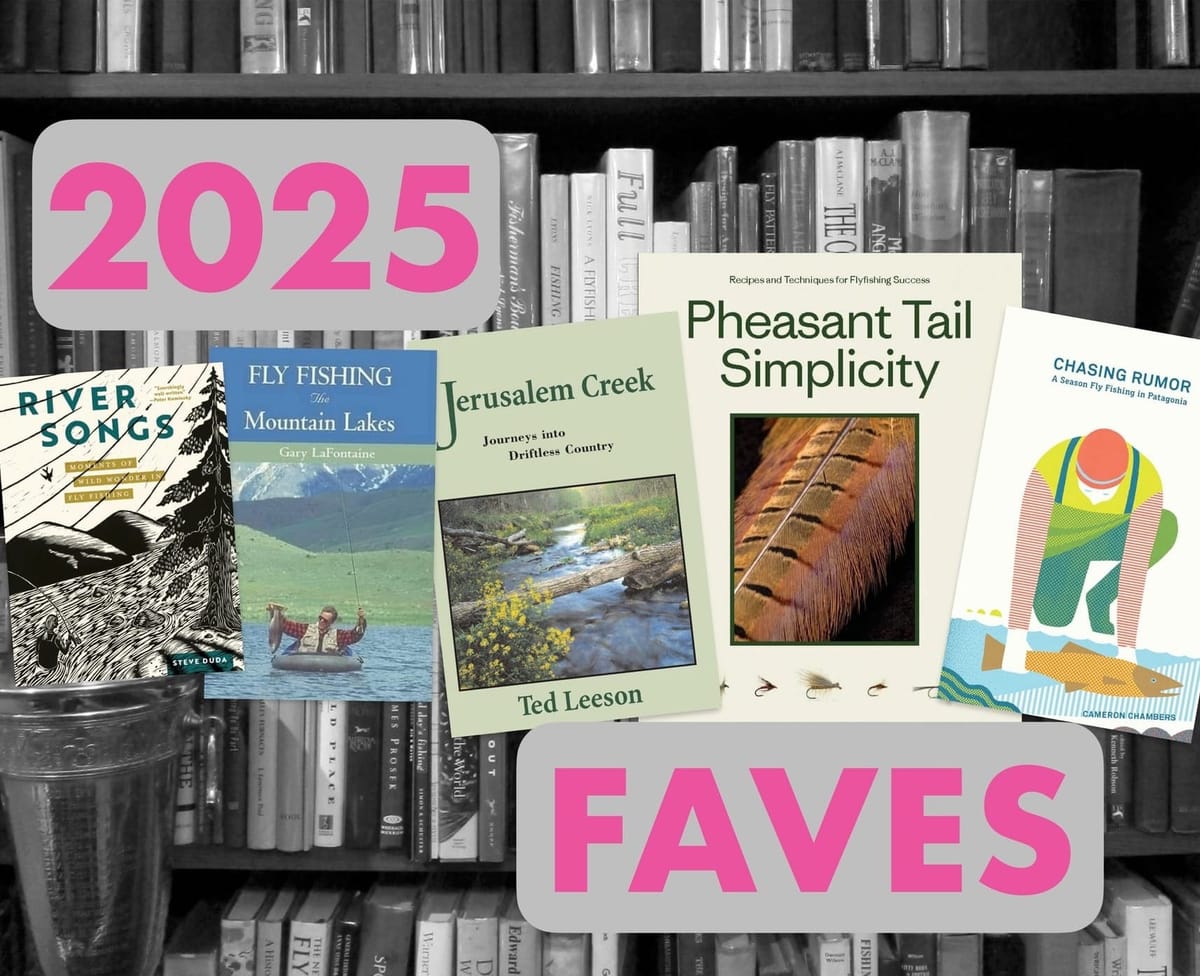
Pheasant Tail Simplicity: Recipes and Techniques for Successful Fly Fishing by Yvon Chouinard, Craig Mathews, and Mauro Mazzo, 2025
What can I say? Surely you're not surprised, if you've been reading this newsletter at all this year. We featured this book six ways to Sunday this autumn because it's great.
I don't think any angling publishers can do the whole package as well as this. Great imagery, fantastic anecdotes, and fine design. Pheasant Tail Simplicity was the best fly fishing book published this year, bar none. It serves as a great introduction to so many cross-currents of the sport for beginners and accomplished anglers alike. Is this such a great book because Yvon C. told them to pull out all the stops and don't spare the horses, and then had a great marketing effort behind it all? Probably. Did they maybe miss a trick in not including a section for absolute beginner fly-typers? Yes. But I don't care, because for my book-buying dollar this team put together a dynamite object.
Will I return to it for depth of feeling, like Leeson's, below? Or consult it, like LaFontaine's, to understand how to analyze fishing situations better? No. Will I take the mindset with me to inform what I pluck out, every time I think about fly selection, from tying to buying, to flipping open a box on the river or lake? Absolutely, yes. Previously, all over CFS.
Fly Fishing the Mountain Lakes, by Gary LaFontaine, 1998
This is an older book, and tough to find without spending a bit, but if you're committed to staying away from other anglers, and doing some real exploring to find fish, this has a ton of great technique. One observation on the quality of technique here, as a bar to clear to make it into the book: At one point LaFontaine details how among his mountain lakes friend group they had developed and / or tested dozens of distinct techniques to use when fly fishing lakes. They fished and tested and evolved and discarded, and GLF took those that stood the test of several seasons and committed them to the book. Now that's what I call depth.
EVERY MEMBER of the group made a list of the ten “most unique and effective” methods for mountain lakes. Seven members and seven lists—there were three techniques that appeared on every list—three that everyone agreed are invaluable when trout in mountain lakes became difficult to catch. Two of the strategies were developed by someone in our group—a guarantee for the “unique” part of the qualifying standards—and the third, a United Kingdom technique, was a certain choice because it was the most exciting approach.
Favorite fly fishing lore books I read in 2025
Jerusalem Creek: Fly Fishing through Driftless Country, by Ted Leeson, 2004
For my money, Ted Leeson is America's greatest fly fishing writer. He's written and co-written dozens of books that have defined technique. One, The Fly Tyer's Benchside Reference is one that stands the test of time, remains an essential book for any fly-tier. And then, as he found his stride, he turned turned his hand to the aspects of the heart that make fishing so essential. To read Leeson's lore books (I'd include Inventing Montana and The Habit of Rivers in that list) is to experience a full palette of all the colors and textures literature can provide, as applied to fishing. Rich with references, extended digressions, and a real heavy interrogation of feelings around friendship, growth, and time, Jerusalem Creek hits so many high notes. It's one of those books I regretted not having read sooner, so I could have the pleasure of re-reading it again.
Chasing Rumor: A Season Fly Fishing in Patagonia, by Cameron Chambers, 2015
"Compare and despair," they say. Probably a good mantra for fishing. Don't let other folks' experiences define your own. It's both a good way to take Chambers after Leeson, and a sentiment Chasing Rumor imparts on its reader.
Chambers, a committed Montana guide, eventually catches enough whiffs of the trout nirvana that is Patagonia to spend a series of seasons working and exploring the tip of South America. If you boiled them down into a twenty-minute Fly Fishing Film Tour video sponsored by an apparel company, there'd be a few boca monsters and some extreme weather. But Chambers takes his time and commits to character studies of shady outfitters, postcards from the rough-hewn landscapes, and a narrative of disappointment and recalibration before finding something resembling enlightenment. I read this one at the recommendation of a guide, who, like many of the best, saw himself at the author's exploration of the rough edge of sanity that comes from an awful lot of fishing.
River Songs: Moments of Wild Wonder in Fly Fishing, by Steve Duda, 2024
This is a compilation of Duda's essays, many of which have appeared in other places. But it's well-sequenced, such that elements aren't repeated, and has a variability that shows range across a variety of forms and themes. There's a peculiar slant in angling writing that often flaunts what's left behind (stable job, normal life). Duda's prose mourns those losses, while exalting in what he's traded up for. I don't have much to detail about this one, but I read a lot of fish stories this year and Duda's phrasing and style got into my head.
OK, well, here's an aside: A lot of writers, given their chance, try and write like they talk. That's advice commonly given: Write like you talk. And it can work pretty well. I'm doing it now. It's the most common voice on this site, especially in the newsletter. Here we are, two buddies. You're reading this on your phone, waiting at the doctor's office, or in the gym at your kid's basketball practice. We're just hanging out.
But when you start to talk about print, everything changes. The stakes get higher. You're betting on hundreds of thousands of pages of paper, stamped with something only possibly produced in your mind. Writers have to rise to the occasion and put on their Sunday best, and grin while Mom pulls that dusty roll of Certs from her purse before she goes up to get the wafer and suddenly you're all alone on the pew. Print is the big show, a matter of intimacy over convenience, a conversation with the gods if there ever was one, a chance at forever. You must serve your best and brightest images and metaphors on every page, and in every sentence. Clunkers send you straight down. Writers like Duda can step up. Not everyone knows how.
Honorable mentions
Everyone knows all fisherman are liars, and when you combine a penchant for fibbing with the self-aggrandizement that memoir usually layers on—whether subtle or overt—things can get over the top. What I loved about these two memoirs was their emotional honesty.
Cast, Catch, Release: Finding Serenity and Purpose through Fly Fishing, by Marina Gibson, 2024
Gibson shines here when grappling with what it takes to truly change your life.
Throwing Feathers in the Wind, by Richard Gorodecky, 2025
Gorodecky approaches even the most remote and exotic with grounded humor and a punchy good nature.
Ten not-directly-fly-fishing-related books I enjoyed in 2025
In no particular order.
Super-Infinite: The Transformations of John Donne, by Katherine Rundell, 2023
If John Donne could do what he did, have such a depth of heart and vivacity, with all the shit that was going on in his epoch, persecution, plague, and penury, what can't we do? Rundell is aflame contemporizing the poet, while taking us back in time.
Shadow Ticket, by Thomas Pynchon, 2025
I, for one, am enjoying this era of Pynchon, when his parables and mystic koans are delivered wrapped in familiar genre conventions. Almost every page in this book had some turn of phrase or syntactic glyph that made me grin with sheer mastery of language. None of us can be Tom, but we can all dream like him.
CABIN: Off the Grid Adventures with a Clueless Craftsman, by Patrick Hutchison, 2025
At the very least contemporary memoir must show change, and Hutchison does a great job creating emotional distance across the span of a couple seasons as he wrassles with becoming a craftsperson. It's as if we're dropped in the middle of someone becoming, out there in the woods. I'm willing to bet a few editors passed on this one and though "this should be a YouTube show". I'm glad it's not.
Creation Lake, by Rachel Kushner, 2025
In Creation Lake, a shadowy protagonist infiltrates a French commune. She surveils and manipulates its members ahead of a showdown with the state around a municipal water project, while becoming increasingly aligned with communications from the group's guru. The guru who's obsessed with tuning into and embodying the real legacy of Neanderthal man. So much so that he's moved into a cave. (Previously.)
Barbarian Days: A Surfing Life, by William Finnegan, 2016
Another epochal kind of memoir, the sort of book it takes a lifetime to write. Early in the life of the Current Flow State project a very kind friend compared some of the writing here to Finnegan's, in this book. So, I decided it was high time to crack it. And, boy, Mark, I am not worthy. But, what an aspiration.
In Praise of Floods: The Untamed River and the Life It Brings, by James C Scott, 2025
This was a previous Read by the River book club pick. Enjoy this little ditty on opening days, as we look forward to our next one:
James, by Percival Everett, 2024
Percival Everett is on my very short list of dream fly fishing buddies. Having read this, and re-read Huckleberry Finn close together, the two are incomparable. Like trying to draw parallels between Candide and the The Grapes of Wrath. In the same way Shadow Ticket draws contemporary American myths into sharp focus via genre, Everett remixes the past to bring a better today into focus.
Billionaire Wilderness: The Ultra-Wealthy and the Remaking of the American West, by Justin Farrell, 2021
Yale professor, social scientist, and Wyoming native Justin Farrell went in depth with its denizens—at both ends of the socioeconomic spectrum—over a five-year research period to understand what makes the ultra-wealthy tick, and how their motivations to recreate at the doorstep of some of America's most storied wildernesses are changing culture. (Previously.)
Moral Ambition: Stop Wasting Your Talent and Start Making a Difference, by Rutger Bregman, translated by Erica Moore, 2025
Bregman urges us all to go out on a limb, and shows examples of how everyday people are the ones that have made a difference, historically. He has just finished giving the Reith Lectures, the BBC's annual flagship lecture series. Give them a listen if you're interested in learning more.
Things Become Other Things: A Walking Memoir, by Craig Mod, 2025
This book has depth and density. Not just through the subject matter, where it's part travelogue, and part reflection on becoming, but also through the form: Steady pacing. Exceptional design, without being overbearing. Fine imagery. A full example of the potential a book can carry. I was a bit worried this one would be "too internet" (see above) but Mod mode-switched effectively.
Send me your favorites!
As you can see, I love reading books. I want to know what you really loved reading last year. I'm always adding to my list. Please share your favorites in the comments.
𓆟 𓆝 𓆟